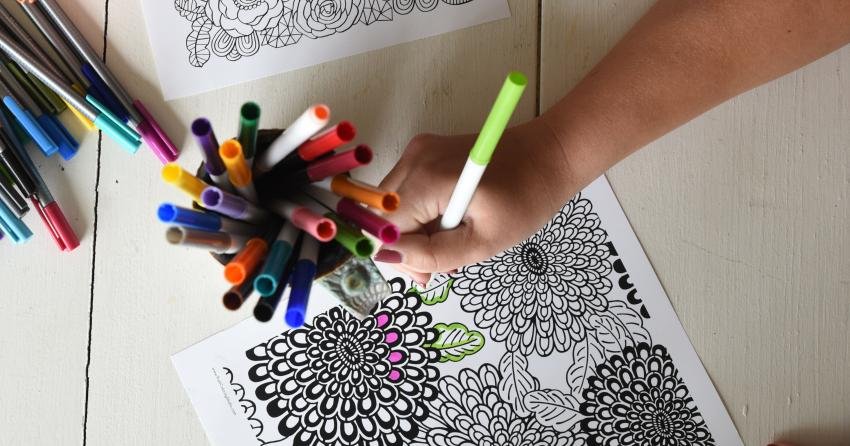
Choosing the right markers for adult coloring can feel overwhelming — the market is flooded with options at wildly different price points, and every coloring community swears by something different. The truth is, the best markers for you depend on your budget, your preferred techniques, and what you plan to color. This guide breaks down the major marker categories from premium to budget, so you can make an informed decision without wasting money on the wrong tool.
Alcohol vs. Water-Based Markers: The Big Debate
Before buying anything, you need to understand the fundamental difference between alcohol-based and water-based markers. This choice shapes everything — blending capability, vibrancy, bleed-through, smell, and paper requirements.
| Feature | Alcohol-Based | Water-Based |
|---|---|---|
| Blending | Seamless gradients, colors flow together effortlessly | Limited; repeated layering can cause pilling |
| Vibrancy | Bold, rich, deeply saturated colors | Lighter, softer, more transparent appearance |
| Bleed-Through | High — needs heavyweight paper | Low — safer for double-sided pages |
| Best For | Large fills, smooth gradients, professional results | Detail work, journals, double-sided coloring books |
| Smell | Strong chemical odor (some brands worse than others) | Odorless or very mild |
| Price | Usually $3–8+ per marker | Usually $0.50–3 per marker |
Many experienced colorists use both types strategically — alcohol markers for bold statement colors and blended backgrounds, water-based markers for detail work and journal-safe coloring.
Premium Pick: Copic Markers
If you're serious about markers and willing to invest, Copic Sketch markers are the undisputed industry standard. Professional illustrators, manga artists, and dedicated colorists worldwide rely on them. The Super Brush nib feels like a natural paintbrush — soft, responsive, and precise. With 358 available colors, refillable ink, and replaceable nibs, Copics are designed to last a lifetime.
A single Copic costs $5–8, and a quality starter set of 24–36 markers runs $150–250. That's a real barrier upfront. But if you color regularly, the refillable design makes them economical long-term — refills cost around $3 and restore a dried pen completely. Our full Copic markers guide for beginners covers the color numbering system, refilling, and the four product lines in detail.
Who should buy: Colorists who plan to color frequently, want professional-quality blending, and view markers as a long-term investment.
Best Value Alternative: Ohuhu Honolulu Markers
Ohuhu Honolulu alcohol markers disrupted the market by delivering quality that genuinely rivals Copic at roughly half the price. Each marker has a dual-tip design — a brush nib on one end and a chisel nib on the other — giving you flexibility without buying separate pens. Available in up to 320 colors, with a growing refillable range.
The blending isn't quite as seamless as Copic's, and the Super Brush nib isn't quite as fine, but for most hobbyist colorists the difference is subtle. If you're not a professional artist, you likely won't feel constrained by Ohuhu's capabilities.
Who should buy: Anyone who wants alcohol marker blending at a reasonable price — excellent for hobby colorists and anyone hesitant to commit $200+ to Copic upfront.
Best for Fine Detail: Arrtx Alcohol Markers
For detailed mandalas, intricate line work, and precision coloring, Arrtx alcohol markers are designed with fine work in mind. Each marker is dual-ended with a fine-tip brush on one end and a standard brush on the other — giving you more precision than a wide chisel. Available in sets up to 128 colors, a 48-count set runs around $30–40.
For fine line drawing and outlining on top of any marker base, the Staedtler Triplus Fineliner is indispensable — a 0.3mm water-based pen with a range of 36 vivid colors that won't bleed or smear over dried markers.
Best for No Bleed-Through (Double-Sided Books & Journals)
If you color double-sided coloring books or journal pages, alcohol markers are your enemy — they'll bleed straight through. These water-based alternatives minimize bleed-through dramatically:
Tombow Dual Brush Pens — water-based with a flexible nylon brush tip and a 1mm fine tip. Excellent blendability for a water-based pen, minimal bleed-through on 28lb+ coated paper, and 96 colors. They're also blendable wet-on-wet using a colorless blender pen. See our full brush pen review for paper test results.
Faber-Castell PITT Artist Pens — India ink-based, waterproof, lightfast, and acid-free. Minimal bleed-through on 28lb+ paper. Best used as detail or accent tools rather than primary coloring media due to the smaller color range and limited blending.
Best Budget Pick: Crayola Super Tips
Crayola Super Tips deserve serious consideration for beginners and casual colorists. At $5–20 per set, they're accessible and available at CVS, Target, Michaels, Walmart, and online. The cone-shaped tip handles both fine lines and broader strokes — held upright for detail, tilted for fill work. Sets come in 20, 50, or 100 colors. See our full Crayola Super Tips review for complete paper and blending tests.
Who should buy: Absolute beginners, casual colorists, and anyone building confidence before investing in premium markers.
Matching Markers to Your Paper
The marker is only half the equation — paper matters just as much. See our complete guide to the best paper for coloring, but the key principle is simple: use at minimum 28lb coated paper with any marker. Standard 20lb printer paper works for water-based markers in a pinch, but always put a scrap sheet underneath.
For alcohol markers, dedicated marker paper (like Canson XL Marker Paper) or heavy cardstock prevents bleed-through entirely. Many colorists also use HP Premium 32lb copy paper as an affordable, widely available alternative.
Pro Tips for Better Marker Results
Always test on scrap first. Different papers react differently to the same marker brand. A marker that bleeds on thin paper might be perfect on coated cardstock. Keep a dedicated scrap sheet for quick tests before committing to your actual page.
Let alcohol markers dry before layering pencil. If you layer colored pencils over markers, wait 2–5 minutes for the ink to fully set. Pencil over wet alcohol ink causes the ink to shift and smear. Once dry, pencils layer beautifully over marker bases for added texture and shading.
Work light to dark. Start with lighter colors, then layer darker tones. Dark over light blends smoothly; light over dark creates muddiness.
Cap immediately after use. Especially critical with alcohol markers — they evaporate quickly when uncapped. Make it a habit. Some colorists store alcohol markers horizontally to keep both ends wet.
Ready to start? Browse our free printable coloring pages — floral, mandala, and botanical designs are all excellent for practicing marker techniques. For a full supply overview including markers, pencils, paper, and gel pens, see our list of 11 must-have coloring supplies for adults.