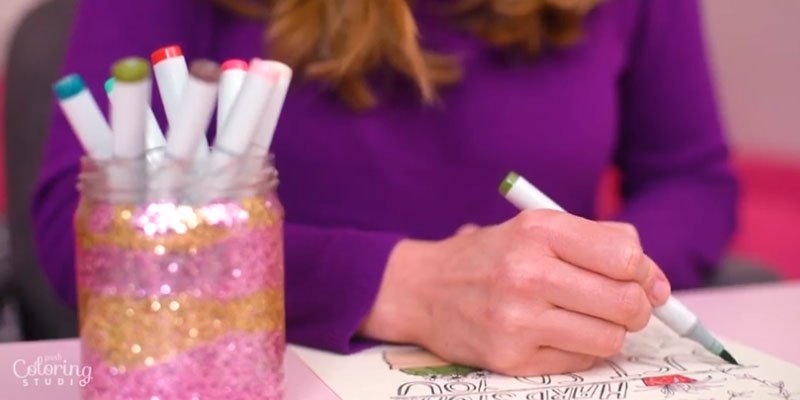
If you've spent any time in coloring or illustration communities, you've heard about Copic markers. They come up in nearly every conversation about professional-quality coloring tools — and the price tags that go with them generate as many questions as the markers themselves. This guide answers the most common beginner questions: what Copic markers are, why they're alcohol-based, how to use them, whether they bleed, how to refill them, and whether they're actually worth the investment.
Watch: Copic Markers for Beginners
What Are Copic Markers?
Copic markers are professional-grade alcohol-based markers made by Too Corporation in Japan. They've been the industry standard for illustrators, manga artists, fashion designers, and architects since 1987. Unlike most markers you'll find at a craft store, Copics are refillable, have replaceable nibs, and come in an unusually large color range of 358 colors — all carefully organized into a logical system of color families and values.
What makes Copic markers stand out is the quality of their blending. Because they use an alcohol-based ink that stays wet briefly after application, you can blend one color directly into another while both are still slightly wet, creating seamless gradients that are genuinely difficult to achieve with any other medium.
Are Copic Markers Alcohol-Based?
Yes — all Copic markers are alcohol-based. This is the key fact that defines almost everything about how they work. Alcohol evaporates faster than water, which means Copics dry quickly and don't cause paper to buckle the way water-based markers can. The alcohol carrier also produces a highly saturated, intensely pigmented color that looks vibrant and consistent.
Because the ink is alcohol-based, it is permanent once dry and has no odor-free option — work in a ventilated space if you're using them for extended sessions. They are not water-soluble and cannot be blended with water. Compare this to water-based markers like the Tombow Dual Brush Pen — different tools with different strengths.
The Copic Marker Lines Explained
Copic makes four different product lines. Understanding the differences helps you buy the right one:
| Line | Best For | Nibs | Colors | Price |
|---|---|---|---|---|
| Copic Sketch | Most popular, best all-rounder | Brush + Super Brush | 358 | $$$ |
| Copic Ciao | Beginners & budget | Brush + Medium Broad | 180 | $$ |
| Copic Classic | Technical drawing | Fine + Medium Broad | 214 | $$$ |
| Copic Wide | Large area coverage | Wide + Super Brush | 36 | $$$$ |
For most beginners, Copic Ciao is the smart entry point. They use the same ink and refill system as Sketch markers but cost slightly less. Once you're committed, Copic Sketch is the professional's choice and the most widely available.
Understanding the Copic Color System
Every Copic color has a code like BG23 or R59. This isn't random — the code tells you exactly what you're getting:
- Letters indicate the color family: R = Red, B = Blue, G = Green, BG = Blue-Green, YG = Yellow-Green, E = Earth/Skin, W = Warm Gray, C = Cool Gray, N = Neutral Gray, T = Toner Gray, V = Violet, Y = Yellow, YR = Yellow-Red (Orange), RV = Red-Violet, BV = Blue-Violet, 0 = Colorless Blender
- First digit indicates saturation (0 = most muted/grey, 9 = most saturated/vivid)
- Second digit indicates value/lightness (0 or 1 = lightest, 9 = darkest)
This means if you have R24 (a light, muted rose), you know R29 will be a darker, more intense red in the same family — and they'll blend beautifully together. This system makes building a harmonious palette logical and reliable.
How to Use Copic Markers
Basic Application
Apply Copic markers with smooth, overlapping strokes. Work quickly — the goal is to re-wet each stroke before the previous one has fully dried so the ink blends seamlessly. If you let a stroke dry before adding the next, you'll see a visible stripe. This is the most common beginner mistake.
Blending Two Colors
To blend two colors together, apply your lighter color first across the full area. Then apply the darker color in the area where you want it to be dominant, letting it overlap slightly into the lighter color while still wet. Immediately go back over the overlap zone with the lighter marker — this pushes the darker ink and softens the transition. Repeat until the blend is smooth.
The Colorless Blender (0)
The Copic Colorless Blender (marker code 0) is essentially a marker filled with pure alcohol solvent — no pigment. Applying it over existing color dilutes and moves the ink. It's useful for softening hard edges, creating highlights by pushing pigment away from an area, and cleaning up mistakes near the edges of a shape.
Working from Light to Dark
Just like colored pencils, always work light to dark with Copics. Apply your lightest color first to establish the base, then layer mid-tones, then shadows. Attempting to lighten a dark area after the fact is very difficult.
Do Copic Markers Bleed?
Yes — Copic markers bleed through most paper. This is a characteristic of all alcohol-based markers, not a defect. Because alcohol penetrates paper differently than water-based ink, the marker will soak through standard copy paper and most coloring book paper.
To prevent bleed-through damaging the page below, always use a protective sheet between pages in a coloring book. For standalone work, use dedicated marker paper or smooth Bristol board — both are designed to be bleed-resistant and produce the best results. Our paper guide covers which surfaces work best.
How to Refill Copic Markers
This is one of the features that makes Copics worth the investment over time. Copic markers are refillable using Copic Ink — sold separately in 25ml bottles for each color. To refill:
- Remove the nib from the marker (use the nib puller included with refill sets, or a coin)
- Place the nib of the ink bottle into the marker barrel
- Gently squeeze the ink bottle until the marker body is saturated (you'll hear/feel the ink absorbing)
- Replace the nib
One 25ml refill bottle typically refills a Sketch marker 10–15 times, making the long-term cost per use significantly lower than replacing markers. Nibs can also be replaced individually when they wear out or fray — no need to buy a whole new marker.
Why Are Copic Markers So Expensive?
A single Copic Sketch marker costs around $8–$10 USD. For a full set of 358, you're looking at a significant investment. The price reflects several real quality advantages:
- Refillable and long-lasting — the body of a Copic marker can last a decade or more
- Replaceable nibs — multiple nib types available (brush, fine, calligraphy, etc.)
- 358-color range — more colors than any other marker system, all perfectly harmonized
- Consistent, professional-grade ink — manufactured to exacting standards
- Industry standard — used professionally in animation studios, fashion houses, and architecture firms worldwide
That said, if you're just beginning, you don't need 358 colors. Start with 12–36 Ciao markers in colors you'll actually use, get a feel for the medium, and expand from there.
Where to Buy Copic Markers
Copic markers are available at most major art supply retailers:
- Amazon — wide selection, competitive pricing, good for building a collection gradually
- Blick Art Materials — excellent selection, occasional sales, reliable stock
- JetPens — great for individual markers and refills, strong community recommendations
- Hobby Lobby, Michaels, and Joann — carry a limited selection in-store, often with coupons that make individual markers much more affordable
Are Copic Markers Right for You?
Copic markers are genuinely worth learning if you color regularly and want professional-quality results. They reward patience and practice with a blending capability that's hard to match. But they're not the only path. If you're newer to coloring or working on a budget, water-based markers like Tombow are a wonderful, more affordable starting point. And if you prefer colored pencils, our guides on blending and white pencil techniques will help you get the most out of that medium.
The best coloring tool is always the one you'll actually use. Pick something in your budget, learn it well, and the rest follows.
Frequently Asked Questions About Copic Markers
Are Copic Sketch or Ciao better for beginners?
Copic Ciao is the smarter starting point. They use the same ink and refill system as Sketch markers but cost slightly less and are sold in smaller sets — easier to start without a big investment. The main difference is the nib: Ciao uses a Medium Broad tip while Sketch uses a Super Brush. Once you're ready to build a serious collection, Copic Sketch is the professional standard used by most illustrators and colorists.
How many Copic colors do I need to start?
Start with 12–36. A good starter range covers the main color families (reds, blues, greens, earth tones) plus a few grays. If you color figures or portraits, add 4–6 skin tones from the E (Earth) family. Build gradually — once you start using them, you'll quickly learn which colors you reach for most and can expand from there.
Do Copic markers bleed through coloring book paper?
Yes — all alcohol-based markers bleed through most standard paper, including most coloring book pages. Always slide a bleed-proof sheet between the pages when working in a book. For standalone work, smooth Bristol board or dedicated marker paper prevents bleed-through and gives the best results. See our paper guide for specific recommendations.
What is the Copic Colorless Blender (0) used for?
The Copic 0 is pure alcohol solvent with no pigment — essentially a marker filled with the same alcohol carrier that carries all Copic ink. Applied over dry color, it dilutes and moves the pigment. Use it to soften hard edges, push color away from an area to create highlights, or clean up small mistakes near the edges of a shape. Always apply it last, after your colors are in place.
Are Copic markers worth the price?
For regular colorists who want professional blending results, yes — especially long-term. A single Copic body can last a decade or more. Refill ink costs a fraction of a new marker, and nibs are individually replaceable. If you're a casual or new colorist, start with Ohuhu or Arteza alcohol markers (same technique, fraction of the price) to learn the medium before committing to Copics.
What's the difference between Copic and Ohuhu markers?
Both are alcohol-based and blend using the same technique. Copic markers are refillable, have replaceable nibs, come in 358 professionally matched colors, and are the industry standard for illustration. Ohuhu markers are not refillable, come in sets of up to 320 colors, and cost a small fraction of Copic. For adult coloring and practice, Ohuhu delivers excellent results. For serious illustration work where long-term color consistency matters, Copic is worth the premium.